Postcard
UI App Design Case Study 2026
Where Travel Plans Go to Die
Planning a group trip is messy, time-consuming, and honestly kind of frustrating. Decisions about where to go, when, what to do, and how much to spend end up scattered across group chats, random links, and multiple apps. Usually, one person ends up doing most of the work while everyone else either stops responding or can’t agree. On top of that, splitting costs and keeping track of who owes what just adds more stress. Most travel tools are built for individuals, not groups, leaving a gap for something that actually makes planning together feel easy and enjoyable.
Making it Actually Happen
Postcard brings group travel planning into one place, making it easier to plan, decide, and book together. Each person shares their preferences, like destination, vibe, budget, and activities, and the app turns it into a trip that feels balanced for everyone. With built-in voting, easy edits, direct booking and cost splitting, it removes the usual back-and-forth and makes sure everyone has a say without slowing things down. By keeping everything in one place, the app turns group travel from chaotic and stressful into something smooth, collaborative, and actually fun.
User Research
To better understand how people plan group trips, I conducted surveys and interviews with over 15 participants. The goal was to uncover common behaviors, frustrations, and gaps in the current planning process.
“Usually one person pays for everything and then has to figure out how to get everyone to pay them back.”
—Female, 22
Through both surveys and interviews, it became clear that group travel planning is often unstructured and relies heavily on group chats, shared notes, and multiple apps. Participants described a process where ideas are quickly discussed, but decisions are delayed or never made. Many rely on one person to take over, leading to imbalance and frustration.
“We talk about it in the group chat, but once it comes to actually planning, no one responds.”
—Female, 21
“If I don’t plan the trip, it doesn’t happen.”
—Male, 22
“There’s too many options and it takes hours to find things everyone agrees on.”
—Survey Response
Key Findings
• Coordination fatigue:
Group chats lead to endless back-and-forth, often resulting in no clear decisions.
• Uneven responsibility:
One person typically plans and pays for everything, while others disengage.
• Financial friction:
Splitting costs is messy, unclear, and often delayed.
• Overwhelming choices:
Users spend hours comparing flights, hotels, and activities across multiple platforms.
User Needs
From the research, users consistently expressed a need for:
• A centralized platform for planning and booking
• A way to easily split and track costs
• Collaborative decision-making tools (voting, shared input)
• Clear, curated recommendations to reduce overwhelm
• A process that feels simple, fast, and fair
85% of users said having one app to plan, book, and split costs would be life-changing.
WIREFRAMES
Onboarding
New Trip Preferences
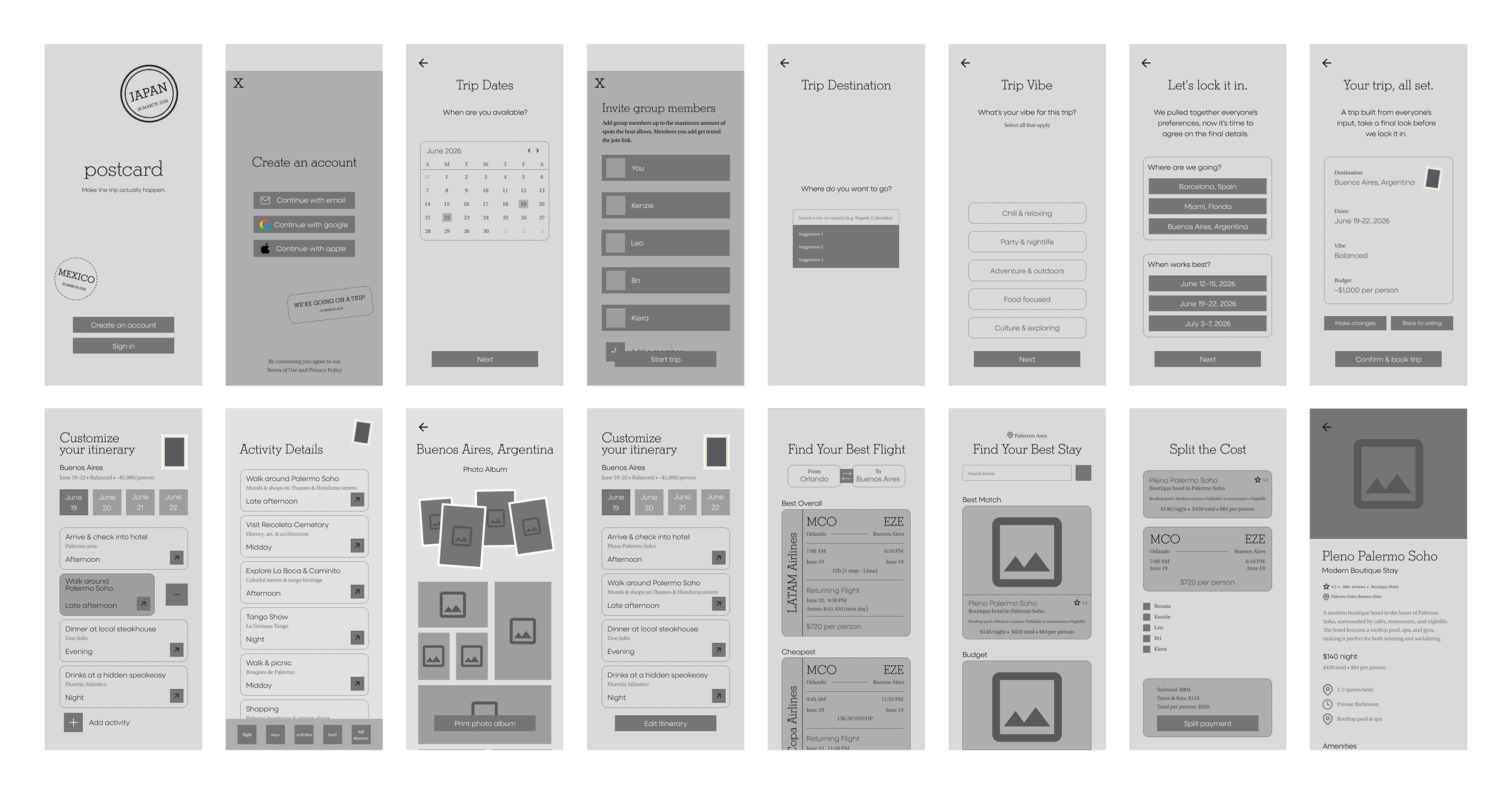
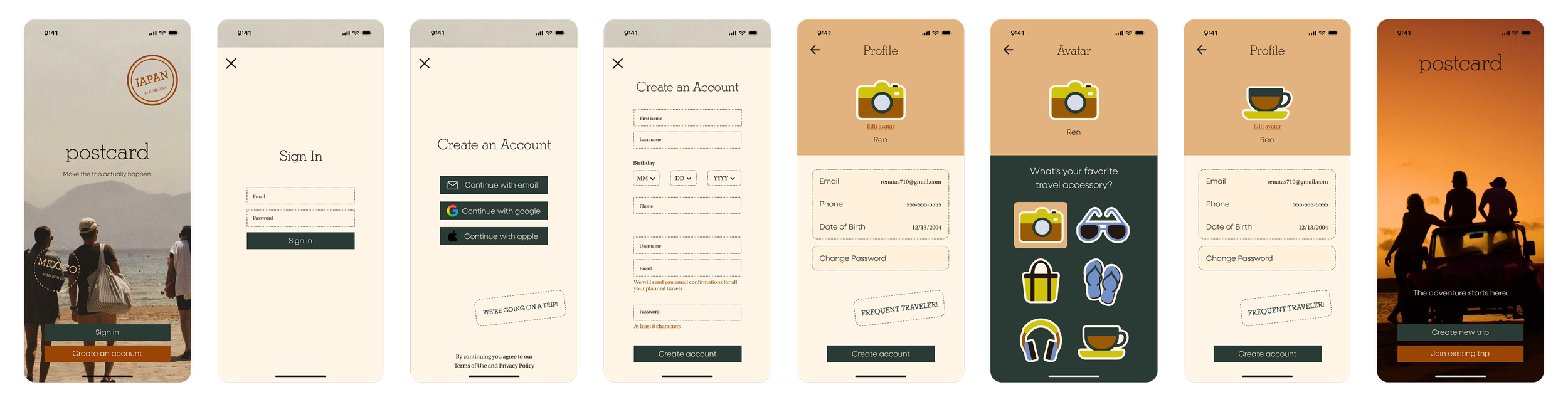
This feature organizes the early stages of trip planning by guiding users through inviting group members, selecting dates, and collecting individual preferences.
Each person inputs their own preferences, like destination, vibe, activities, and budget, so everyone has a say from the beginning. This replaces unstructured group chat conversations with a clear, collaborative starting point for the trip.
Voting
After preferences are submitted, the app uses a voting system to help the group make decisions together. Members can vote on key parts of the trip, replacing messy group chat discussions with a clear and fair process.
This keeps planning moving forward while ensuring everyone has a voice.
Booking
Booking happens directly within the app, with recommended flights and stays based on the group’s preferences. Members can vote on options to decide together, or search for additional choices if needed.
This keeps the entire process in one place, making booking faster, simpler, and more collaborative.
Itinerary
After booking, Postcard creates a personalized itinerary based on the group’s trip. Users can edit, swap, and add activities, making it a flexible and collaborative planning tool.
This gives the group structure while still allowing for personalization.
Trip Dashboard
After booking and planning, the trip dashboard organizes everything in one place, including itinerary details and booking confirmations.
This makes it easy for the group to stay organized without switching between multiple apps.
Home Page
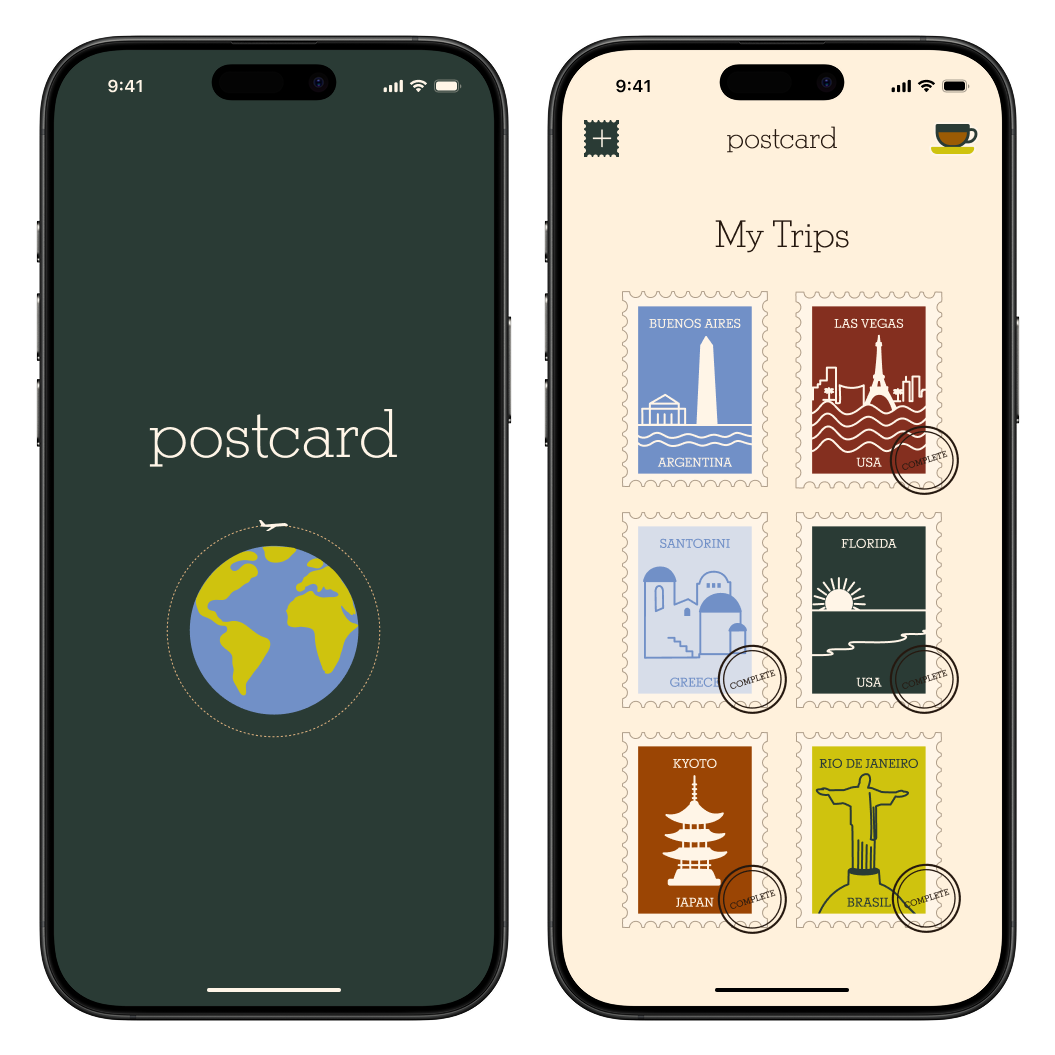
The home page acts as the main hub for all trips, both upcoming and completed. When navigating to a completed trip, users can revisit their experience by adding photos to a shared album, printing a physical photo book, and leaving reviews.
Branding

Project Takeaways
This project showed how challenging group decision-making can be without structure. Research revealed that the biggest issue wasn’t planning itself, but getting everyone to agree and stay engaged.
Designing features like voting, shared preferences, and cost splitting helped reduce friction and make the process feel fair. Overall, the project emphasized the importance of simplifying complex experiences and designing with collaboration in mind.